Clay
GTM data enrichment platform with 150+ provider waterfall, AI research agents (Claygents), LinkedIn job change signals, and workflow automation for revenue teams.
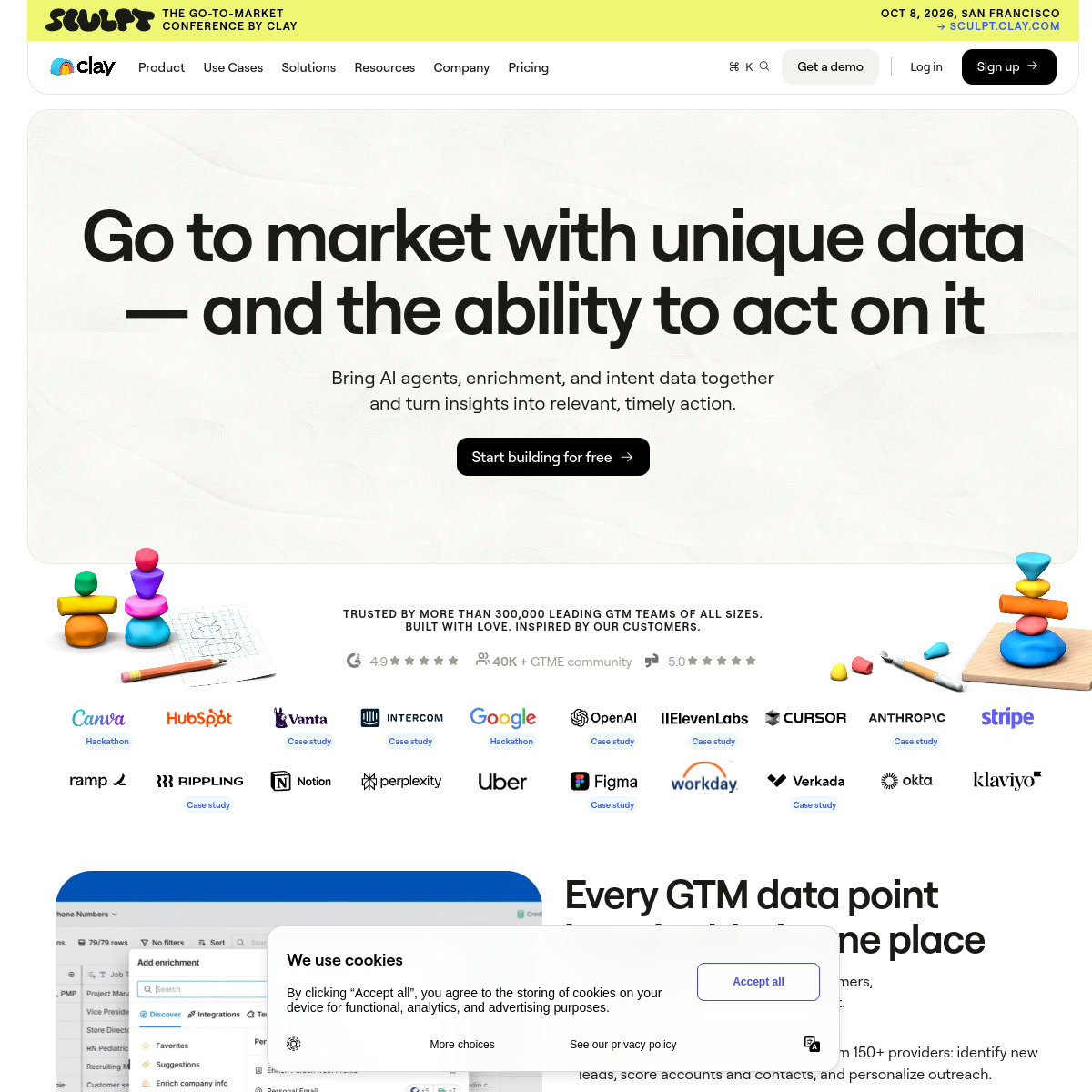
Clay: LinkedIn Data Enrichment Platform for GTM Teams Running Multi-Source Outreach (2026)
Clay is a go-to-market data platform—built by Clay.com—that aggregates 150+ data providers (including LinkedIn signals, job change alerts, and firmographic sources) into a single spreadsheet-like workspace, letting revenue teams build hyper-personalized outreach without maintaining separate enrichment subscriptions. Clay is best suited for GTM engineers, RevOps teams, and growth-focused sales orgs that want programmatic control over their data pipelines. Teams that need a simple point-and-click sequencing tool with zero technical setup will find Clay's learning curve steep.
Key Specs
| Feature | Detail |
|---|---|
| Primary use case | Multi-source data enrichment + GTM workflow automation |
| Best for | RevOps, GTM engineers, growth sales teams (10-500 people) |
| Deployment type | Cloud web app + API |
| LinkedIn compliance claim | No direct LinkedIn scraping; uses 3rd-party data providers |
| Daily connection limit | N/A (not a LinkedIn outreach tool directly) |
| Safety features | No LinkedIn session cookies accessed; API-based enrichment |
| Sales Navigator required | Optional; integrates via 3rd-party providers |
| InMail support | No native InMail |
| Sequence builder | Yes - native Clay Sequencer + integrations with Instantly, Smartlead, Salesloft |
| CRM integrations | Salesforce, HubSpot, Pipedrive + Zapier/webhooks |
| Email enrichment | Yes - waterfall from 150+ providers (Apollo, Hunter, Prospeo, etc.) |
| Team features | Shared tables, role permissions, collaborative workflows |
| API availability | Yes - Clay API for programmatic table operations |
| Pricing model | Credit-based (credits consumed per enrichment action) |
| Free plan | Yes - Free plan with 100 credits/month |
| Paid plans | Starter $149/mo, Explorer $349/mo, Pro $800/mo, Custom enterprise |
What Clay Does Well
Waterfall Enrichment Across 150+ Providers
Instead of buying separate subscriptions to Apollo, Clearbit, Hunter, and ZoomInfo, Clay lets you cascade through all of them in a single workflow stopping the waterfall when a valid email or phone is found. This means you pay per verified result rather than for unlimited unused seats.
AI Research Agents (Claygents)
Claygents are AI agents that can browse the web, read LinkedIn profiles, analyze company pages, and extract structured data into your Clay table. This enables automated research tasks like identifying whether a company recently raised funding or expanded to a new market without manual browsing.
LinkedIn Signal Tracking
Clay integrates with providers that surface LinkedIn job change signals, hiring intent data, and profile update events. GTM teams use this to trigger outreach the moment a champion changes jobs - one of the highest-converting sales triggers available.
Flexible Workflow Automation
Clay tables function like programmable spreadsheets with APIs attached. Teams can build end-to-end GTM plays: pull a list from LinkedIn search, enrich it, score it with AI, personalize email copy, and push to a sequencer - all inside one connected workflow.
Known Limitations
- LinkedIn ToS risk: Clay itself does not scrape LinkedIn, but the data providers it connects to may use methods that violate LinkedIn ToS. Clay's compliance depends on the individual provider selected.
- Steep learning curve: Non-technical users often need 2-4 weeks to build effective workflows; Clay's own University and Slack community help but the tool is not beginner-friendly out of the box.
- Credit costs add up quickly: Each enrichment step costs credits; complex workflows on large lists can exhaust monthly credits fast, pushing teams to $800+/mo plans.
- Not a native LinkedIn automation tool: Clay does not send connection requests or InMails - you need separate tools like Expandi or Dripify for LinkedIn outreach sequences.
- Pricing opacity: The free plan's 100 credits per month is very limited for real prospecting; most production workflows require at least the $349 Explorer plan.
Best For
- RevOps teams building automated lead scoring and enrichment pipelines
- GTM engineers who want API-level control over data without building custom integrations
- Growth-stage startups (Series A-C) that need to scale outbound efficiently without a full data team
- Sales teams running account-based marketing who need hyper-personalized variables at scale
Who Should Look Elsewhere
- Solopreneurs or SDRs who need a simple plug-and-play LinkedIn outreach sequence - use Expandi or Dripify instead
- Teams with no technical resources to configure waterfall enrichment workflows - Clay requires meaningful setup time
- Companies needing direct LinkedIn InMail automation - Clay does not send messages on LinkedIn natively
LinkedIn Safety and Compliance
Clay does not access LinkedIn directly - it uses third-party enrichment providers that surface LinkedIn data. This means your LinkedIn account is not at risk from using Clay. However, data accuracy and compliance depend on which providers you activate within Clay's marketplace. Some providers aggregate LinkedIn data via methods that may vary in ToS compliance. Clay's own platform has no LinkedIn ban risk, but verify each data source's compliance separately if your organization has strict legal requirements around data sourcing.
Pricing and Cost at Scale
- Free: 100 credits/month - enough for testing, not production
- Starter: $149/month - approximately 2,000 credits, suitable for small experiments
- Explorer: $349/month - approximately 10,000 credits, solo SDR at moderate volume
- Pro: $800/month - approximately 50,000 credits, small team (3-5 SDRs)
- Custom/Enterprise: negotiated, typically $2,000-$5,000/month for agencies and large orgs
Cost estimate: A solo SDR doing 500 enriched contacts/week needs roughly Explorer ($349/mo). A 5-person SDR team needs Pro or custom. Agencies running multiple client campaigns typically spend $2,000-$5,000/month.
Integrations and Workflow Fit
Clay integrates natively with HubSpot, Salesforce, Pipedrive, Slack, Gmail, Airtable, and most major sequencers (Instantly, Smartlead, Salesloft, Outreach). It also connects to Zapier and Make for custom automations, and offers a REST API for programmatic table management. Clay fits best as the enrichment and routing layer in a broader GTM stack - feeding data to your CRM and sequencer, not replacing them.
Getting Started
- Sign up for free at clay.com - no credit card needed
- Connect your first data source (e.g., a CSV of leads or a LinkedIn search export)
- Add enrichment columns using Clay's provider marketplace (start with email waterfall)
- Configure a Claygent to add AI-researched personalization variables
- Push enriched, personalized leads to your sequencer or CRM
Pro tip: Use Clay's template library to start with pre-built job change trigger or fundraising signal workflows rather than building from scratch - saves 3-5 hours on first setup.
What Users Are Saying
Clay has a very active community on Reddit (r/clay, r/sales, r/leadgeneration) with frequent posts about creative use cases including scraping hiring pages, building ICP scoring models, and chaining Claygents for deep research. Common praise: flexibility and coverage. Common complaints: credit costs and initial complexity. Some users on r/sales report spending 2-3x their initial budget estimate after underestimating enrichment costs per workflow run.
FAQ
Will Clay get my LinkedIn account banned?
No - Clay does not access your LinkedIn account. It uses third-party data providers. Your LinkedIn session is not involved, so there is no ban risk from Clay itself.
Is there a real free plan?
Yes, Clay offers 100 free credits/month with no credit card required. This is enough to test a small workflow but insufficient for ongoing prospecting at volume.
Do I need Sales Navigator to use Clay?
No - Sales Navigator is not required. Clay connects to many LinkedIn data providers that do not require Sales Navigator. Advanced filters and signal data quality can improve with Sales Nav data providers.
Is Clay cloud-based or a browser extension?
Clay is fully cloud-based - there is no browser extension. All work happens in the web app and via API.
Can Clay send LinkedIn messages or connection requests?
No - Clay is a data enrichment platform, not a LinkedIn outreach tool. You need a separate tool (Expandi, Dripify, Heyreach) to send LinkedIn outreach. Clay feeds data to those tools.
How do credits work?
Each action in Clay such as finding an email, running a Claygent, or calling an API costs credits. Credit costs vary by provider and action type. Most plans include a set monthly credit allocation; overages can be purchased.
Sources
Reviews
No reviews yetSimilar tools in category

ContentIn
Generate high-quality written content tailored to your needs.

Crystal Knows
A platform that analyzes personality traits to enhance communication and collaboration.

Grammarly
An AI-powered writing assistant that enhances clarity, grammar, and style in your text.