Common Room
AI-powered buyer intelligence platform unifying LinkedIn enrichment, 400M+ contact directory, buyer signals, and RoomieAI agents for B2B GTM execution.
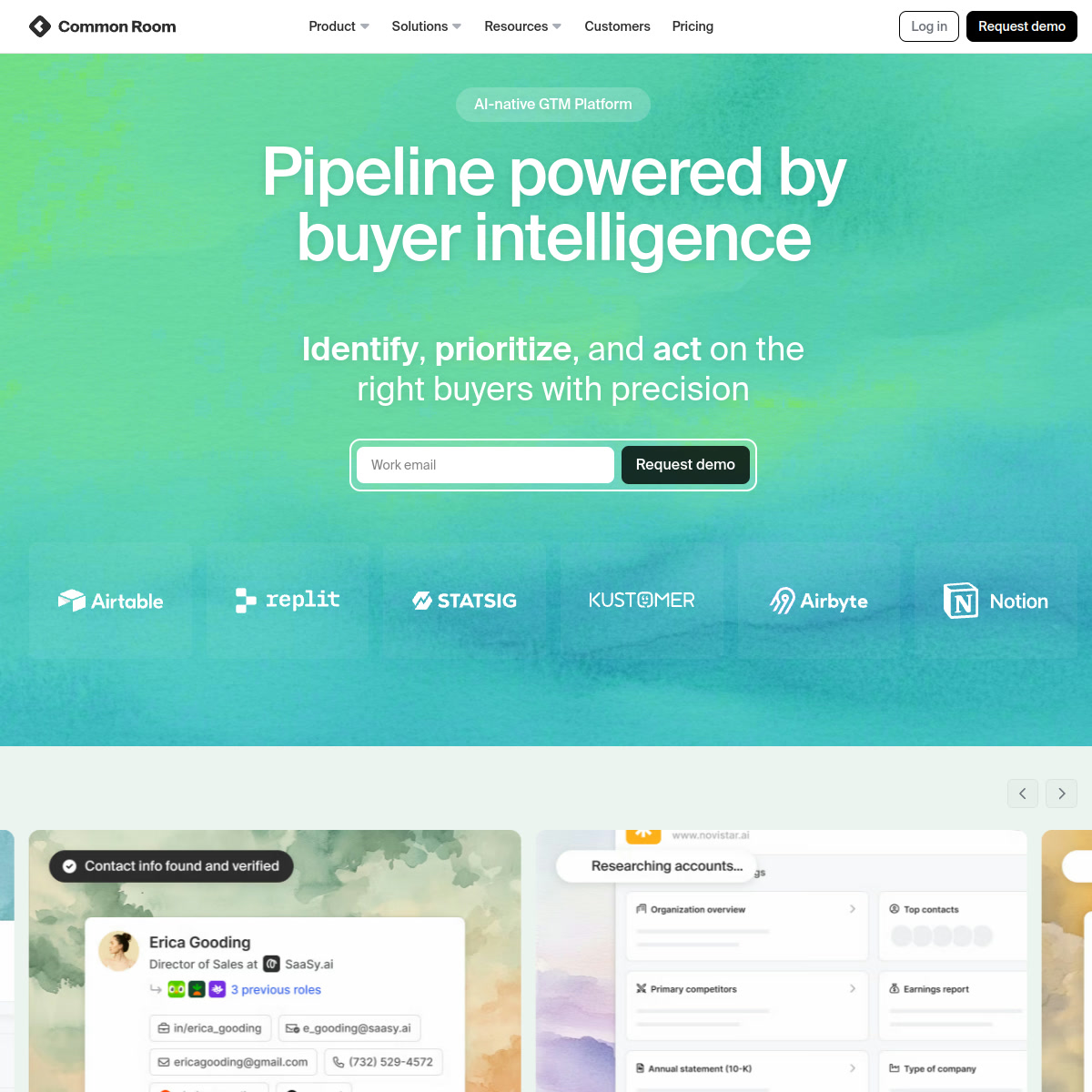
Common Room: LinkedIn Intelligence Platform for AI-Powered Buyer Enrichment and Signal-Based Selling (2026)
Common Room is an AI-powered revenue intelligence platform built by Common Room, Inc. that unifies LinkedIn profile enrichment, buyer signals, and AI agents into a single GTM execution system. The platform consolidates what previously required separate tools for enrichment (ZoomInfo, Apollo), intent data (Bombora, 6sense), and AI research (ChatGPT, Clay) into one continuous-refresh buyer intelligence layer. Common Room is designed for B2B sales and revenue operations teams that need to identify in-market buyers, enrich contact data at scale, and automate personalized outreach — not for individual recruiters or small teams looking for basic LinkedIn profile lookups.
Key Specs
| Spec | Details |
|---|---|
| Primary use case | Buyer intelligence: enrichment + signals + AI agents for GTM execution |
| Best for | B2B sales teams, RevOps, demand gen, and enterprise GTM organizations |
| Deployment type | Web app with Salesforce, Slack, email, and MCP server integrations |
| LinkedIn compliance claim | Uses LinkedIn profile data for enrichment; no automation of LinkedIn actions |
| Daily connection limit | N/A — no LinkedIn messaging or connection automation |
| Safety features | SOC 2 certified; GDPR compliant; no LinkedIn ToS violation risk for enrichment use |
| Sales Navigator required | Not required; integrates with existing sales stack |
| InMail support | Not supported — no direct LinkedIn messaging |
| Sequence builder | Via SEP integration (Outreach, Salesloft, etc.) — AI drafts, human sends |
| CRM integrations | Salesforce, HubSpot; full CRM sync across all plans |
| Email enrichment | Yes — 400M+ contact directory via AI waterfall enrichment |
| Team features | Rep Home workspace, shared account intelligence, team-level Prospector credits |
| API availability | MCP server (Model Context Protocol) — available across all plans |
| Pricing model | Tiered subscription — Essential, Advanced, Enterprise |
| Free plan | None |
| Paid plans | Contact for pricing — demo required; positioned as ZoomInfo alternative at ~20% of ZoomInfo cost |
What Common Room Does Well
Continuous AI Waterfall Enrichment at Scale
Common Room's enrichment engine runs continuously against its 400M+ contact directory, refreshing buyer and account data without requiring manual re-enrichment cycles. Unlike static databases such as ZoomInfo or Apollo where data can be months out of date, Common Room's Context360™ technology resolves, deduplicates, and updates person-level records on an ongoing basis. This means sales reps are working with current LinkedIn job titles, contact details, and account information rather than stale exports.
RoomieAI™ Agents for Account Research and Personalization
RoomieAI™ agents automate the account research and message personalization work that typically consumes 10+ hours per week per SDR. The AI agents surface the right accounts based on buyer signals, research each contact's background and trigger events, and draft personalized outreach messages grounded in the platform's buyer intelligence data. Because the AI is grounded in Common Room's enrichment layer rather than general internet data, outputs are specific and accurate enough for revenue teams to trust without manual fact-checking on each message.
Context360™ Buyer Intelligence and Signal Unification
Common Room's Context360™ system de-fragments first-party CRM data and combines it with real-world buyer signals — LinkedIn profile changes, job movements, intent signals, product usage data (on higher tiers), and account-level triggers. This gives revenue teams a unified view of who is in-market and why, rather than working from isolated data points across multiple tools. The platform also identifies buying committee members automatically, mapping multiple contacts within a target account to their roles in the purchase decision.
MCP Server Integration for AI Assistant Workflows
Common Room ships an MCP (Model Context Protocol) server across all plans, enabling AI assistants and agents — including tools like Claude or custom GPTs — to access buyer intelligence directly via standardized API calls. This is a relatively rare feature in the enrichment space and positions Common Room as infrastructure for AI-native sales workflows, not just a standalone SaaS application. Sales engineers and RevOps teams can extend Common Room's intelligence into custom agents, Slack bots, or CRM automations without building custom data pipelines.
Known Limitations
- No public pricing: All three tiers (Essential, Advanced, Enterprise) require a demo conversation to get pricing. The only public pricing benchmark is the company's own comparison to ZoomInfo, stating Common Room costs approximately 20% of ZoomInfo's price — but exact figures are not disclosed. Budget planning without a sales call is not possible.
- No direct LinkedIn outreach automation: Common Room enriches LinkedIn profile data and surfaces buyer intelligence, but does not automate LinkedIn connection requests, messages, or InMails. Teams needing direct LinkedIn outreach automation will need to pair Common Room with a separate tool.
- Enterprise-oriented complexity: The full platform — with product signal integration, data exports, RoomieAI™ agents, and Prospector — is designed for mature GTM organizations with dedicated RevOps resources. Smaller teams without existing CRM infrastructure may struggle to extract full value from the platform.
- Prospector credits are tiered: The number of contact lookups (Prospector credits) scales with plan tier. Essential plan has the lowest credit allotment, which may create bottlenecks for high-volume outbound teams. Additional credits can be purchased as add-ons.
- Product signal integration limited to higher tiers: Connecting your own product usage data (in-app behavior, trial activity) to Common Room's buyer intelligence layer requires the Enterprise tier — a meaningful limitation for PLG (product-led growth) companies that need this signal most.
Best For
- B2B sales teams replacing ZoomInfo or Apollo: Teams spending heavily on static contact databases and manual re-enrichment workflows will find Common Room's continuous-refresh model a meaningful upgrade — particularly those at scale where data decay creates measurable pipeline loss.
- RevOps teams building AI-native GTM stacks: The MCP server and RoomieAI™ agents make Common Room a foundational layer for organizations building AI-first revenue workflows, not just another enrichment vendor to stitch together manually.
- Enterprise GTM organizations with complex buying committees: Common Room's buying committee mapping, Context360™ intelligence, and multi-seat team features are designed for enterprise deal cycles where multiple stakeholders need to be identified, enriched, and engaged across a long sales cycle.
- PLG companies with product signal data (Enterprise tier): For product-led growth companies that have trial or freemium users, the Enterprise tier's product signal integration enables a powerful motion: identify which free users match ICP, combine with LinkedIn enrichment, and prioritize for sales outreach based on actual product engagement.
Who Should Look Elsewhere
- Individual SDRs or freelancers: Without public pricing or a self-serve option, and with features optimized for team-level workflows, Common Room is not positioned for solo practitioners. Tools like Apollo.io or Hunter.io offer self-serve contact enrichment at accessible price points.
- Teams needing direct LinkedIn automation: Common Room does not send LinkedIn messages or connection requests. If your core workflow depends on automated LinkedIn outreach sequences, you need a tool like Expandi, Dripify, or Linked Helper — Common Room provides the intelligence layer, not the outreach execution for LinkedIn specifically.
- Startups with no CRM infrastructure: Common Room's value compounds with CRM data and existing contact records. Teams that are pre-CRM or using spreadsheets will not extract meaningful value from the platform's signal unification and context features.
How Common Room Works with LinkedIn
Common Room uses LinkedIn profile data as a primary enrichment source within its 400M+ contact directory. When a sales rep looks up a contact in Common Room, the platform surfaces LinkedIn-sourced data including current and past job titles, company, location, and seniority — combined with other enrichment sources for coverage completeness. Common Room does not automate LinkedIn actions (no connection requests, no DMs, no InMails), which means it carries no LinkedIn Terms of Service violation risk for its enrichment use. The platform's LinkedIn data usage falls under standard B2B data licensing and enrichment practices, consistent with how established vendors like ZoomInfo or Clearbit handle LinkedIn-sourced professional data. Teams can use Common Room to identify and research LinkedIn contacts, then take action manually or via their SEP (sales engagement platform) — keeping LinkedIn automation risk at zero while benefiting from rich LinkedIn-sourced profile intelligence.
Pricing & Cost at Scale
Common Room offers three named tiers — Essential, Advanced, and Enterprise — but does not publish specific prices. Based on the company's public positioning:
- Essential: Core enrichment + RoomieAI™ + Prospector + key integrations (CRM, SEP, Slack, MCP). Designed for teams getting started with signal-based selling.
- Advanced: More contacts, more Prospector credits, deeper RoomieAI™ capacity. For teams scaling outbound.
- Enterprise: Product signal integration, auto-recurring data exports, expanded seats, dedicated support. For complex GTM organizations at scale.
- DataAgent add-on: Full data quality and deduplication management — available as an add-on to any tier.
Pricing benchmark: Common Room publicly states its Prospector is "around 20% of ZoomInfo's cost" — suggesting meaningful savings for high-volume enrichment use cases. ZoomInfo enterprise contracts typically run $15,000-$50,000+/year, implying Common Room may be positioned in the $3,000-$10,000+/year range, but this is an inference, not a published price. Contact Common Room for a demo and specific quote.
All plans include: CRM integration, SEP integration, Slack, and MCP server access.
Integrations & Workflow Fit
Common Room integrates natively with Salesforce, HubSpot, Outreach, Salesloft, and Slack across all plans. The MCP server enables AI assistant integrations with tools like Claude, custom GPTs, and internal AI agents — a differentiator that makes Common Room accessible wherever sales work happens, not just inside the Common Room web app. Rep Home is Common Room's in-app workspace where individual reps access account intelligence, Spark alerts, and AI-drafted messages without switching contexts. For teams using Salesforce, Common Room's RoomieAI™ agents can surface intelligence directly within Salesforce records. Data export is available via CSV on all plans and via auto-recurring exports on Enterprise. The platform is SOC 2 certified and GDPR compliant, with data access, retention, and deletion controls for enterprise governance requirements.
Getting Started
- Request a demo: Common Room requires a demo conversation to match your GTM motion to the right plan tier — no self-serve sign-up is available. Visit commonroom.io and submit a demo request.
- Connect your CRM: After onboarding, connect Salesforce or HubSpot to sync existing account and contact records. This gives Common Room the first-party data foundation for Context360™ enrichment and signal matching.
- Configure RoomieAI™ agents: Define your ICP and outreach goals so RoomieAI™ can begin surfacing prioritized accounts and drafting research summaries and message personalization.
- Enable Prospector for new contact discovery: Use the 400M+ contact directory to find and enrich new contacts matching your ICP, supplementing your existing CRM data with fresh LinkedIn-sourced profiles.
- Integrate with your SEP: Connect Outreach, Salesloft, or another sales engagement platform so AI-drafted messages and prioritized contacts flow directly into your outreach sequences.
Pro tip: Enable the MCP server early in your deployment. Even if your team isn't running custom AI agents yet, having Common Room's buyer intelligence accessible via MCP creates an extensibility layer that compounds in value as your organization's AI tool stack matures.
What Users Are Saying
Common Room is positioned as a ZoomInfo alternative and receives positive coverage in B2B sales communities for its data freshness and AI research capabilities. On G2, Common Room earns consistent praise for its contact enrichment coverage and the quality of RoomieAI™-generated account summaries. Reviewers in enterprise sales environments highlight the time saved on manual account research as a key value driver. Critical feedback focuses on the learning curve for full platform adoption and the absence of published pricing making budget approval processes more complex internally. Community discussion on Reddit's r/sales and r/salesforce mentions Common Room occasionally as a ZoomInfo alternative, particularly in threads about enrichment tool comparisons, though volume is moderate compared to established players.
Sources checked: commonroom.io, G2.com listing for Common Room, Reddit r/sales search. Specific Reddit thread URLs not available at time of publication.
FAQ
Does Common Room automate LinkedIn outreach?
No — Common Room enriches LinkedIn profile data and surfaces buyer intelligence but does not send LinkedIn connection requests, DMs, or InMails. Outreach is executed via your connected SEP (Outreach, Salesloft) or manually by reps. This means no LinkedIn ToS violation risk for Common Room users.
How does Common Room compare to ZoomInfo?
Common Room is positioned at approximately 20% of ZoomInfo's cost while offering continuous AI enrichment, buyer signal unification, and built-in AI agents (RoomieAI™) that ZoomInfo does not include natively. ZoomInfo has broader name recognition and a larger existing customer base, but Common Room's AI-native approach appeals to teams building modern, signal-based GTM motions. Both require enterprise contracts; neither offers self-serve access.
What is Context360™?
Context360™ is Common Room's proprietary buyer intelligence system that de-fragments first-party CRM data and combines it with enriched LinkedIn profile data, buyer signals, and real-world triggers (job changes, funding events, intent data) into a continuously refreshed, unified account and contact intelligence layer. It is the core engine behind Common Room's enrichment, signal prioritization, and AI agent capabilities.
Is Common Room SOC 2 certified and GDPR compliant?
Yes — Common Room is SOC 2 certified and fully GDPR compliant. Data is encrypted in transit and at rest, and the platform provides controls for data access, retention, and deletion. Full security documentation is available at commonroom.io/security.
What is the MCP server and why does it matter?
MCP (Model Context Protocol) is an open standard for connecting AI assistants to external data sources. Common Room ships an MCP server on all plans, meaning AI tools like Claude, custom GPTs, or internal AI agents can query Common Room's buyer intelligence directly via API. This enables AI-native workflows where your organization's AI assistants have access to enriched, current contact and account data without manual data export steps.
Can I use Common Room without a CRM?
Technically yes, but you lose significant value. Common Room's intelligence compounds with existing CRM records — the platform enriches, deduplicates, and signals against data you already have. Without a CRM, you're limited to prospecting new contacts via the Prospector feature, missing the Context360™ enrichment and signal-matching that is Common Room's core differentiator for most teams.
Sources
Reviews
No reviews yetSimilar tools in category

ContentIn
Generate high-quality written content tailored to your needs.

Crystal Knows
A platform that analyzes personality traits to enhance communication and collaboration.

Grammarly
An AI-powered writing assistant that enhances clarity, grammar, and style in your text.